Relative Speed Monitoring in Elite Football: A Smarter Way to Track Conditioning

Written By Blake Ashby - Adelaide United A‑League Men, Performance Coach
Relative Speed Monitoring in Elite Football
Download the full report from Blake Ashby: FULL ARTICLE
Why sprint exposure, conditioning load and individual speed bands matter more than ever
Elite football has long relied on absolute speed thresholds to track high-speed running and sprinting. Those benchmarks are useful for comparing players, teams and competitions, but they do not always show how demanding a session is for the individual athlete. When maximal sprint speed differs across a squad, the same running speed can represent very different physical stress from one player to the next.
That is where relative speed monitoring becomes valuable.
Rather than viewing speed through one universal lens, relative monitoring measures running intensity as a percentage of each athlete’s maximal sprint speed. This gives coaches and practitioners a clearer picture of how hard an athlete is really working, helping them individualise training load, improve prescription and better manage sprint exposure across the week.
Why absolute thresholds only tell part of the story
Traditional metrics still have a place. They help with benchmarking, reporting and external comparison. But in applied environments, they can mask the true physiological intensity experienced by different athletes.
A simple example makes the point clearly. If two players both hit 19.8 km/h, that may represent around 66% of maximal sprint speed for one athlete and only 56% for another. On paper, the output looks the same. In practice, the load is not. Relative speed monitoring helps correct that gap by framing intensity around the athlete, not just the number.
A practical relative speed framework
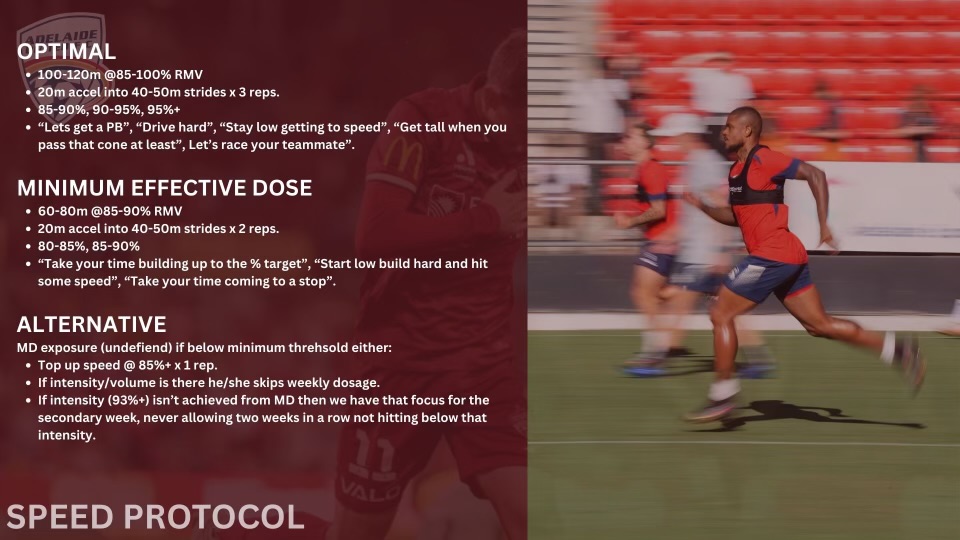
The report proposes a simple three-band model for monitoring linear running demands in elite football:
Band 3: 55–70% of maximal sprint speed
Band 4: 70–85% of maximal sprint speed
Band 5: 85–100% of maximal sprint speed
From there, practitioners can build more useful locomotor metrics. Relative hard running combines Band 3 and Band 4. Relative high-speed running combines Band 4 and Band 5. Sprint exposure sits in Band 5. Together, these measures offer a more practical way to understand how athletes are moving relative to their own capacity.
Why weekly sprint exposure matters
One of the strongest takeaways from the report is that sprint exposure should not be treated as an occasional by-product of training. It should be a deliberate part of the weekly process.
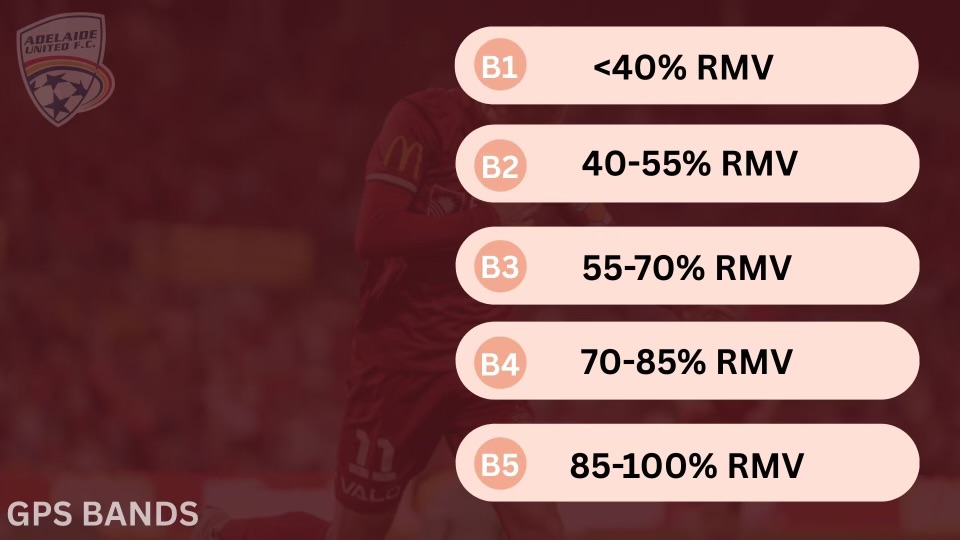
Regular exposure to speeds above 85% of maximal sprint speed can support performance development while also contributing to neuromuscular readiness and tissue resilience. In practical terms, that means ensuring athletes receive at least one meaningful sprint stimulus within a seven to nine day cycle, with weekly monitoring used to assess who has and has not reached that exposure target.
The framework also outlines simple sprint exposure options depending on the schedule. In short turnaround weeks, the target may be a minimum effective dose of 60–80 metres at roughly 85–93% MSS. In more normal weeks, that can build to 80–120 metres above 85% MSS through progressively faster strides. It is a practical way to keep speed in the program without creating unnecessary fatigue.
Conditioning should not stop once the season starts
Another key idea is that conditioning should extend beyond pre-season.
The report argues that pre-season should build athletes toward workloads around 130–150% of match demands, creating a buffer that improves resilience across the season. But once competition begins, the aim should not simply be to maintain availability for the next match. It should also be to preserve and gradually develop physical capacity through carefully planned exposures embedded within the weekly schedule.
To guide that process, the framework highlights a few core metrics. Relative hard running may sit around 800–1000 metres per match and 1800–2000 metres across the week. Relative high-speed running may sit around 150–250 metres per match and 350–450 metres across the week. Metres per minute also remains an important marker of session intensity. These targets can be achieved through a mix of structured conditioning, transition drills, repeat sprint work and large-sided football-specific games.
A smarter way to view football load
Importantly, the report acknowledges that football is not only a linear running sport. Accelerations, decelerations and changes of direction all matter and should be considered within a broader athlete monitoring system. But as a practical model for managing sprint exposure and conditioning load, relative speed monitoring offers a clearer starting point for understanding what athletes are actually experiencing.
For performance teams, that is the real opportunity. Not just collecting more data, but using better context to make stronger decisions.
Relative speed monitoring does not replace absolute benchmarks. It strengthens them. Used together, they provide a more complete way to track load, prescribe conditioning and prepare athletes for the real demands of the modern game.
To access the rest of the report, including the full framework, sprint exposure protocols and season-long conditioning targets, Download Now.
Connect with Blake
https://www.linkedin.com/in/blake-ashby-384263188/
https://www.instagram.com/bash.performance/